The Evolution of Basketball in New York City: A Nostalgic Journey

by Thomas Beller,
July 20, 2015, An article edited from "The New Yorker" magazine.
Basketball is more than just a game; it's a vibrant tapestry woven into the fabric of New York City. The version we see on television is just one of many. Basketball can be played solo or in groups, indoors or outdoors, on full courts, half courts, or even makeshift hoops. N.B.A. players who venture abroad must adapt to the rules of FIBA, the international governing body. Remember Tim Duncan’s blunt remark at the 2004 Olympics? “FIBA sucks.”
Was that guy shooting hoops alone on Ninety-Seventh Street really playing basketball? As John Starks, the former Knick, would say, “Most definitely!”
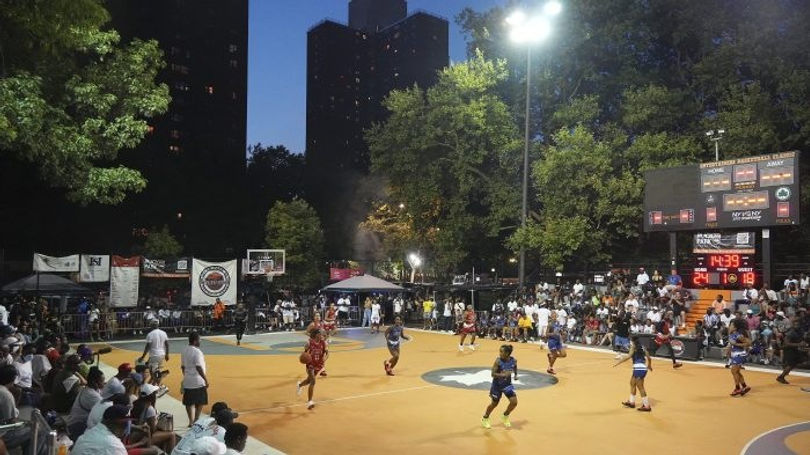
The Playground Culture of NYC Basketball
When Bill Bradley, another former Knick, ran for Senate in New Jersey, his commercials featured him tossing a crumpled paper into a tiny hoop attached to a trash can. Is that basketball? You could argue it is! In the documentary “Doin’ It in the Park: Pick-Up Basketball, NYC,” an old-timer from Harlem recalls how local playground courts were so crowded that kids had to settle for shooting hoops into garbage cans off to the side.
The culture of New York City playground basketball looms large in the history of the N.B.A. Several generations of the game’s greatest players owe their basketball education to New York’s Department of Parks and Recreation.
It was fitting that the N.B.A. used the 2015 All-Star Game at Madison Square Garden to celebrate this legacy with a magnificently detailed map titled “A History of New York City Basketball.” This map is filled with notable locations and links to short videos. Each of the five boroughs has its own section, highlighting special categories for “point guards” and “playgrounds.” Streetball and ball handling are intertwined, and New York is known for its fierce point guards. The video chronicles the history of legends like Bob Cousy, Dick McGuire, Tiny Archibald, and many more.
The Legacy of Greatness
The segment on Manhattan focuses on its most famous product, Kareem Abdul-Jabbar, who claims, “I was raised in Manhattan, so I learned the game right in the heart of the city.” He reflects on his local playground, emphasizing its role in his basketball initiation. “I never consciously made a connection between basketball and how it is tied to life in New York City,” he admits, while the camera captures the court bathed in morning light.
As much as I appreciated the N.B.A.'s history lesson, it deepened my sense that this historical moment is fading. Streetball in New York is on the decline. Over the past decade, I’ve watched playgrounds that once buzzed with activity become eerily quiet. I’m not suggesting a mass extinction, but there are definitely fewer playgrounds and players. The ones who do show up seem older. For instance, Kareem’s playground had only a few players shooting alone on a recent afternoon. A river that runs low may eventually run dry.
The Changing Landscape
The observation that New York’s basketball courts are not as populated as they once were is based on anecdotal evidence. This evidence is mostly limited to Manhattan. When I read a Times report about the wealthy residents of the Time Warner Center—who aren’t from here—I realized that this luxurious building is less than ten blocks from the projects that once produced many of the players at my childhood basketball court in Riverside Park at 76th Street. Can billionaires play ball? That’s a different city game altogether.
I’m not claiming the courts are empty. For example, up on St. Nicholas Terrace, about ten blocks from where Kareem played, I found a respectable half-court game in progress. But no one had “next.” The courts on Horatio Street and Hudson, where Joakim Noah once dunked on me at age fourteen, are now devoid of pick-up basketball in the afternoons. The Tompkins Square Park courts are mostly empty, and the courts on 20th and Second Avenue, where many from Tompkins sought refuge, are now barren.
A Personal Reflection
I don’t even live in New York anymore. I visit for a few weeks during the winter holidays and a couple of months in the summer. Am I being paranoid? Is this just nostalgia, a projection of that terrible feeling that the world of my childhood is vanishing?
Where are the youth? Are they playing video games at home? Playing soccer?
My life as a streetball player began when I was twelve. It was the middle of winter at the basketball court in Riverside Park, at 76th Street. The day was bright but freezing, with enormous sheets of ice floating on the Hudson. The asphalt was dusted white with salt and frost, catching the sun's glare. I looked down at my ball and my hands, buried in black wool gloves. Around me was a vast expanse of empty courts. I see these images, and the white clouds from my breath, as if I were watching Super-8 footage. Sun-struck, silent, magical—it was freezing, but I was lost in a fantasy of buzzer-beating shots, variations on imagined heroics, the naked orange rim framing a circle of blue sky that I sought to fill over and over. The hypnotic, syncopated sound of the bouncing ball echoed in my ears.
I was on the junior-varsity basketball team and had spent years playing in school gyms. But this was the first time I thought of that patch of asphalt as a resource in my life, a place to retreat and seek solace. On that freezing day in 1977, I was all alone.
The Global Talent Pool
Perhaps the city game is in eclipse because the talent pool is now global. Journalist Rick Telander highlighted this in his 1974 book, “Heaven is a Playground.” In the early 1970s, colleges across the country realized they could tap into New York City’s streetball talent.
In the ESPN “30 for 30” episode on Bernard King, he recalled an assistant coach from the University of Tennessee showing up at the Fort Greene housing projects, and he thought, “Does this guy have any idea of where he is?” This recruiting revolution was partly due to Rodney Parker, a playground-basketball impresario who worked the phones and shopped playground talent across the country.
This exporting of talent from New York to other regions no longer happens. Why? Perhaps the very qualities that once made New York ball players exceptional—their moves, toughness, and creativity—are now seen as hindrances.
The Birthplace of Streetball
In “Doin’ It in the Park,” García and Couliau suggest that New York produced so many great ball-handling guards because it is the birthplace of the improvised game “21,” a basketball version of “kill the carrier.” Toughness and singularity of vision are what the city breeds in its players.
Basketball courts are everywhere in New York. They are like prehistoric manifestations of the city—like old-growth forests. But they didn’t just grow there; someone put them there. The unlikely patron saint of New York as a basketball Mecca was Robert Moses. According to Alex Garvin, author of “The Planning Game,” New York has more public parks than any other city in the country. Twenty-five percent of New York’s territory is devoted to public parks, the largest percentage of any city in America.
Voices of the Game
In “Doin’ It in the Park,” García and Couliau interview players from multiple generations, all striving to articulate what makes streetball special. The speakers may not be famous, but they are legends in their own right, known by their nicknames: Shamgod, Sundance, Homicide, Fly. Kenny (The Jet) Smith recalls, “I never had a more rush, to this day, since the first time I played street basketball.” He adds, “My most vivid memory ... EVER ... is the first day I won on the three-on-three in the back.”
My first winter of dribbling in gloves eventually gave way to spring. Other players began to appear at the court on 76th Street. I was tall, skinny, and uncoordinated. Against common sense, I tried to join these games. I felt as if I had immigrated to another country, marinating in this foreign culture until I understood it and was accepted. It’s been a long wait.
I played with guys whose nicknames were Birdie, Puppet, Red, and Cello. I would arrive at the court and ask who had next. When I found that person, I would say, “You have your five?” They would usually nod, yes, sometimes looking me straight in the eye, as if they hoped I grasped that this was a bald-faced lie and wanted to see the insult register on my face. But I came back.
There was one guy, Rudie, a TV writer who always seemed a bit depressed. It was a loud, buoyant scene, but also crazed. Birdie was a basketball dandy—quick and a very good shot, but he hated contact. Puppet was a wild delinquent with athletic talent. I never dared ask why he was called Puppet. Red was an old alcoholic who talked nonstop trash, wearing outrageously large knee pads. He had a curious glamour about him, suggesting long-past glory that he could still, occasionally, approach. Cello was loud and aggressive, very good in a Barkley sort of way. He stopped showing up at some point. A year later, I heard he had been thrown down an elevator shaft. He survived, but his legs didn’t.
The Struggles of a New Player
My role in this game was like that of a crash-test dummy—though with a mouth. I occasionally got punched or dunked on, but sometimes people would offer me tips. “Keep the ball above your head! Don’t dribble!” I was always told to go down low. It felt like the post—near the basket—was a prison. It took me twenty years to break out. Meanwhile, people still talk to me like I’m a project. I used to hate it, but now I embrace it. It makes me feel like I still have potential.
I didn’t have heart; I had a kind of dogged masochism that kept me returning. What is it about basketball? Alexander Wolff, in his book “Big Game, Small World,” explores this addictive mystery at the heart of the game. He recounts how James Naismith once saw a young boy throwing a ball into a basket. An hour later, he saw the same boy still shooting. When Naismith asked why he practiced so long, the boy replied he didn’t know; he just liked to see if he could make a basket every time he threw the ball.
A Shift in the Game
My favorite scene in “Doin’ It in the Park” features a fierce one-on-one game that draws a crowd. Among them is a loud, funny guy who could be described as a comedian, heckler, drunk, or dangerous individual. He paces, shouts, and makes a fool of himself, but he’s also a bit scary. The sense of being in the presence of some unmanaged force, in a place where there’s no front desk to complain to, is both upsetting and thrilling.
Now, compare that to a scene from the summer of 2015 in Riverside Park, at 76th Street, on a Saturday morning. The place that once buzzed with players was now empty except for two groups. One was an old, lean firecracker taking shots. He had popped an Achilles tendon a while back and no longer played, but his movements suggested he was once pretty good. I shot around with him while, a few courts away, Rob Sergeant, a formidable figure who once played professional basketball in Europe, worked out a kid who was maybe twelve, or ten, or eight, with no apparent physical gifts.
Would I have been a better player had I received one-on-one personal training from a top-level athlete instead of being smacked around and trash-talked by Tweety, Cello, Red, and Puppet? Probably. Yet, something about this picture seemed off, like a “Bowling Alone” applied to streetball.
The Vanishing Youth
My daughter wandered over, and somehow Nelson, the guy I was shooting with, got onto the subject of stickball, conjuring a teeming, unsupervised world of childhood. It sounded as remote as it would have been for me, as a kid, to hear of women with parasols and men with wide-brimmed hats.
The idea that talent should avoid the concrete of playgrounds isn’t new. Bernard King never played at the Tillary Street courts near his home; his brother Albert, a former N.B.A. player, did. Something about the swagger of those young ballers made me follow them into the church lobby. I saw the staircase they took, and after dropping my daughter at camp, I wound my way through the maze of hallways until I found myself at a small window overlooking a modest-sized basketball court. A group of players of different sizes was being put through a rigorous workout by a coach.
Ashton Coughlin—who played basketball for Collegiate, then Wesleyan, and was working as a coach at Riverside Church—wandered down the hall just then. I stopped him to ask a question. As punishment for chatting with me that day, he has had to deal with me writing to him every year or so with more questions about the mysterious vanishing of youth from the city game.
The answer, clearly, in addition to the influx of foreign billionaires at the Time Warner Center and everywhere else in New York, video games, and other distractions, is that the players who are genuinely interested in basketball are not playing on the playground. They are in the basketball version of pre-med, which is what I was watching down on the court.
The legacy of basketball in New York City is rich and complex. It’s a story of passion, evolution, and a longing for the vibrant culture that once thrived on the courts. As we celebrate this incredible 120-year legacy, let’s ensure that the fascinating history of basketball in New York City is preserved, easily accessible, and never forgotten!


Comments